


Cyberattacks are becoming bigger, longer, and more expensive. According to the newly released 2026 IBM Cost of a Data Breach Report, Canadian organizations are now paying a record average of CA$7.11 million per incident — the highest figure ever recorded in the study’s history.
The report reveals a concerning pivot in threat actors’ tactics: hackers are increasingly targeting critical infrastructure and leveraging vendor ecosystems to infiltrate high-value targets.
Energy Sector Emerges as Canada’s Most Expensive Target
For the first time, energy companies overtook technology as the costliest industry for cyber breaches in Canada. The average financial impact by sector stood at:
-
Energy: CA$9.21 million per breach;
-
Technology: CA$9.02 million per breach;
-
Industrial / Manufacturing: CA$8.89 million per breach.
“Attackers are increasingly targeting sectors where disruption creates real operational and economic consequences, while also looking for the weakest link in the supply chain,” said Chris Sicard, IBM Canada Security Leader. “When breaches affect energy, industrial, and technology organizations, every connected supplier expands the attack surface.”
Supply-Chain Compromise: The #1 Cost Amplifier
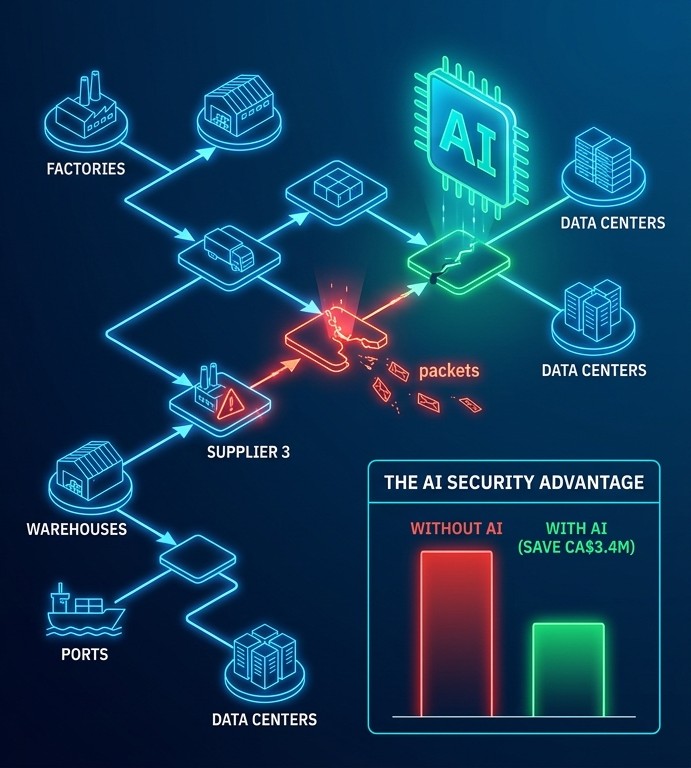
Interconnectivity is fast becoming a major corporate vulnerability. The IBM study highlights supply-chain compromise as the single largest driver increasing breach costs in Canada, adding an average of CA$367,899 to the total bill.
Even companies with top-tier cybersecurity defenses are falling victim through trusted third-party vendors, contractors, and software providers.
Other key factors amplifying breach losses include:
-
Cybersecurity skills shortages: Added CA$314,500 on average.
-
Threat prioritization challenges: Added CA$311,300 on average.
Furthermore, attack scales are expanding. The average number of compromised records rose 8% year-over-year to 28,500, while the average breach lifecycle stretched to 205 days.
The AI Advantage: A $3.41 Million Lifesaver
While cyber threats escalate, defensive technology is delivering massive ROI. Organizations that extensively deployed AI and security automation reported average breach costs of CA$5.5 million, compared to CA$8.91 million for those with no AI deployment.
That translates to an immediate CA$3.41 million savings per breach.
| Defense Metric | Extensive AI & Automation | No AI Deployed |
| Average Breach Cost | CA$5.50M | CA$8.91M |
| Days to Detect | 124 days | 154 days |
| Days to Contain | 57 days | 71 days |
However, criminals are adopting the same tech: 28% of Canadian organizations reported experiencing an AI-generated attack, highlighting how rapidly threat actors are weaponizing generative models.
4 Strategic Recommendations for Executive Leaders
To mitigate risks and lower response times, IBM recommends the following priorities:
-
Strengthen Identity & Access Management (IAM): Secure identity controls to prevent credential-based entry.
-
Gain Visibility Into Vendor Ecosystems: Implement strict third-party risk management for supply chain partners.
-
Scale AI Defense Mechanisms: Automate detection and threat hunting to act before damage spreads.
-
Regularly Test Incident Response Plans: Conduct stress-tests to drastically shorten breach containment lifecycles.
AI-generated image: Gemini


